Barbershop Client Churn Prevention Using Analytics: Catch Fading Clients Before They're Gone
Why Barbershop Client Churn Prevention Using Analytics Matters More Than You Think
Most barbershop owners worry about no-shows and empty chairs, but a quieter problem drains revenue faster: high-spending clients who simply stop coming as often. They don't cancel. They don't complain. Their gaps between visits stretch from four weeks to six, then to ten, and one day you realize you haven't seen them in months. By the time you notice, they're already someone else's regular.
The good news is that this type of client drift leaves a clear data trail. Every visit, every dollar spent, and every gap between appointments lives inside your booking platform. The challenge is knowing how to read that trail quickly enough to act while the client is still warm — before a gentle nudge feels awkward or, worse, too late. That is exactly what this guide covers: a practical analytics workflow inside VuriumBook's online booking and shop management platform to find at-risk, high-value clients and bring them back with targeted SMS outreach.
Step One: Define What "High-Value" and "At-Risk" Actually Mean for Your Shop
Before you open any report, you need a working definition for two client categories. Without clear thresholds, you end up either chasing everyone or chasing no one.
High-value: A client whose average spend per visit and overall visit history put them in the upper tier of your book. This is not strictly about the most expensive services — it is the combination of spend per visit and visit regularity. A client who books a standard cut every three weeks is often worth more annually than someone who books a premium service once every four months.
At-risk: A high-value client whose time since their last visit has exceeded their personal baseline interval by a meaningful margin. If someone normally comes in every three weeks and it has now been six weeks, their pattern has broken. That gap is your signal.
Setting these thresholds does not need to be complicated. Start simple: flag any client in your top revenue tier who has gone at least fifty percent longer than their usual interval without rebooking. Adjust those numbers as you learn what works for your specific clientele.
High-Value vs. At-Risk Client
High-Value Client
- •strong spend per visit
- •books consistently
- •long visit history
- •likely has a preferred barber
At-Risk Client
- •same profile but gap since last visit is growing
- •no upcoming appointment
- •no recent communication from your shop
Step Two: Pull the Right Data From VuriumBook's Analytics
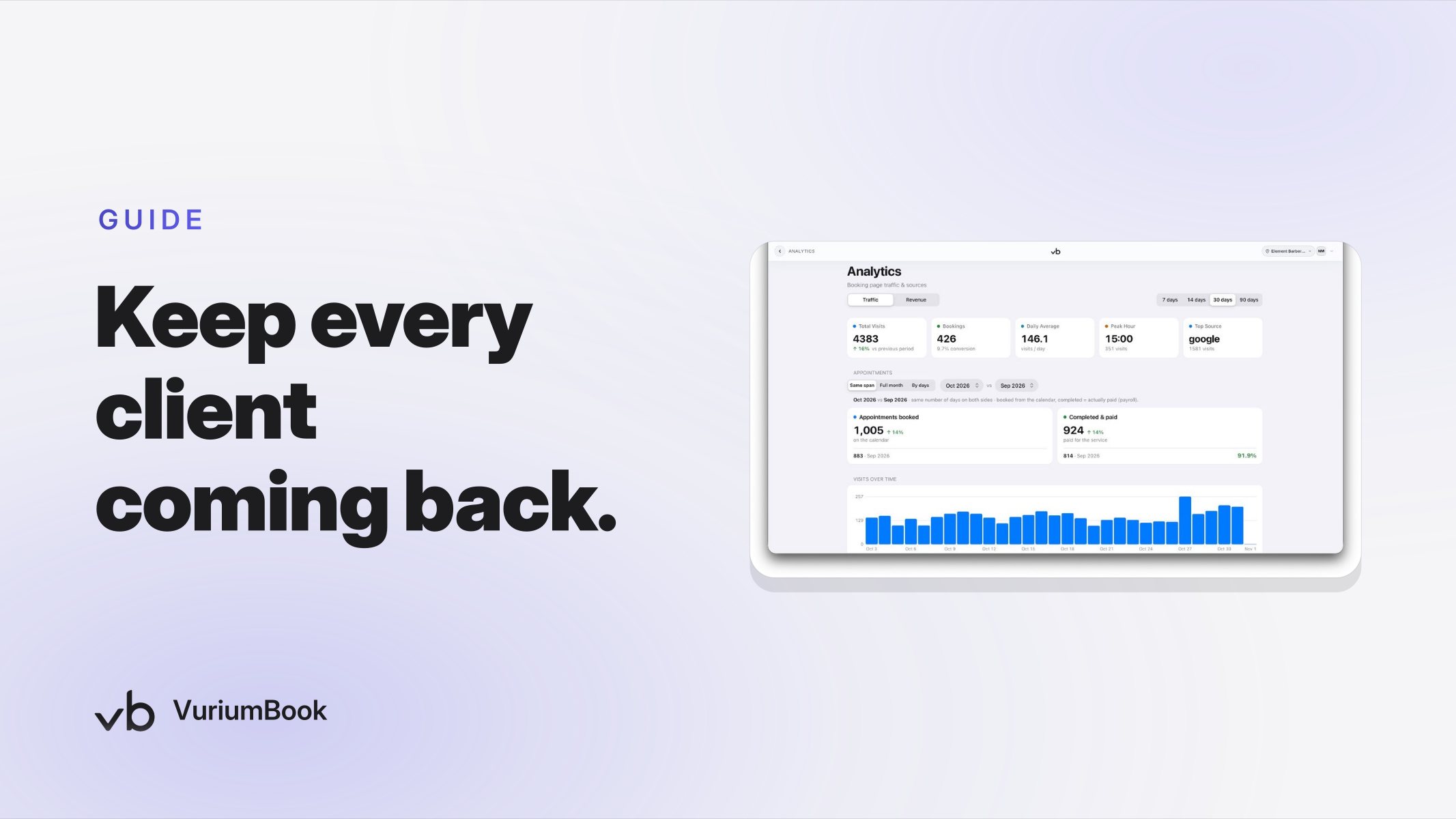
VuriumBook's analytics section holds the client visit history and revenue data you need. The goal of this step is to produce a short, actionable list — not a spreadsheet of your entire client database. You want names you can do something about this week.
Work through the following sequence inside the platform:
Analytics Workflow for At-Risk Clients
When you open a client's record in VuriumBook, you can see their full appointment history, services booked, and total spend. That record is where you confirm whether the gap you spotted in the aggregate data is a genuine pattern shift or a one-off holiday delay. Fall, for example, tends to bring schedule disruptions — school schedules change, routines shift — so a single missed cycle in late October is not always alarming. But two or three missed cycles from a client who was previously like clockwork is worth acting on regardless of the season.
Keep your initial outreach list tight. A focused list of fifteen to thirty genuinely at-risk, high-value clients is far more productive than a mass blast to hundreds of people with mixed histories. Quality of targeting beats volume every time.
Step Three: Use Client Records to Personalize Your Outreach
Generic re-engagement messages feel like spam. Personalized ones feel like service. VuriumBook's client records give you exactly the details you need to make an SMS feel like it came from someone who actually knows the client — because it does.
Before you write a single message, pull these details from the client's record for each person on your list:
- Their preferred barber — Mention them by name when possible. A message that references a specific barber feels personal, not automated.
- Their usual service — If they always book a fade with a lineup, reference that specifically. Vague messages get ignored; specific ones get responses.
- Their last visit date — You don't need to say "our records show you haven't been in for sixty-two days." But knowing the gap informs the tone: a six-week gap calls for a softer check-in, while a four-month gap may warrant a more direct hook.
- Any membership or gift card balance — If a client has an active membership or unused gift card credit, referencing that unused value is a compelling, honest reason to reach out.
With those details in hand, your SMS can be short and human. Something along the lines of: "Hey Marcus — it's been a while since we've seen you at the shop. [Barber name] has openings this week if you're due for a fade. Here's the link to grab your spot." That message takes thirty seconds to read and thirty seconds to act on. That is the goal.
For more on building detailed, actionable client profiles, the Barbershop Service Performance Analytics by Barber guide covers how to read per-barber data alongside client history to make those connections even sharper.
Step Four: Send the SMS at the Right Moment
Timing an outreach SMS is part art, part logic. A few practical principles hold up consistently in real shop environments:
Send mid-week, mid-morning. Tuesday through Thursday mornings tend to see better response rates for appointment-related messages than Friday afternoons or Monday mornings when inboxes and schedules are already hectic.
Don't wait too long. The moment a high-value client's pattern breaks is the best time to reach out. The longer the gap grows, the more your shop fades from their awareness. A gentle nudge at week five or six is a natural check-in. A message at month four can feel out of the blue and is easier to ignore.
Keep it short and link directly to booking. SMS outreach works best when the path from message to booked appointment has as few steps as possible. VuriumBook's online booking page gives clients a direct link to schedule with a specific barber, which removes friction at exactly the moment you need them to act.
Follow up once, not repeatedly. If a client doesn't respond to your first message within a week, one follow-up is reasonable. More than that crosses into nuisance territory and risks damaging the relationship you're trying to salvage.
Step Five: Track What the Outreach Actually Produces
Sending messages is only half the work. The other half is knowing whether they worked so you can improve the next round.
After your outreach campaign, return to VuriumBook's analytics and check a few things:
- How many clients on your list booked an appointment within two weeks of your message?
- Of those who booked, did they return at their previous spend level or lower?
- Which barbers had the highest re-engagement rate when mentioned by name?
- Which client segments — by service type, membership status, or visit frequency — responded best?
These answers let you refine your at-risk definition and your outreach approach over time. You may find that clients who book premium services respond better to messages from their specific barber, while clients with memberships respond best when you reference their unused plan value. That kind of pattern is only visible when you close the loop with data after each outreach cycle.
If your shop runs an active membership program, pair this workflow with your membership analytics. Clients whose membership visit cadence is dropping are at-risk in a particularly measurable way — and reaching them before they cancel is far easier than winning them back after. The Barbershop Membership Revenue Analytics guide walks through how to track visit frequency by tier, which feeds directly into this kind of early-warning system.
Honest Trade-Offs to Keep in Mind
This workflow is genuinely powerful, but it is not a magic fix. A few realities are worth naming directly:
Not every at-risk client is recoverable. Some clients move neighborhoods. Some have life changes that genuinely take them off the table. Your outreach is an invitation, not a guarantee. A well-targeted campaign that recovers even a handful of high-value clients more than justifies the effort, but calibrate your expectations accordingly.
Personalization takes time. Pulling individual client records and writing customized messages is more work than a mass blast. The trade-off is meaningfully better results. If your shop has a large client base, prioritize ruthlessly — focus only on your highest-value at-risk clients each cycle rather than trying to personally outreach to everyone at once.
Analytics are only as good as your data. If client records are incomplete — missing service histories, notes, or contact information — the workflow breaks down. Building a clean client database is a prerequisite, not an afterthought. Consistent data entry after every appointment pays compounding dividends over time.
Make At-Risk Client Detection a Routine, Not a Reaction
The shops that handle churn best are not the ones that react to it fastest — they are the ones that check for it on a schedule before it becomes a crisis. Building a monthly or bi-weekly analytics review into your routine means you are always working from a short, current list of clients worth re-engaging, rather than scrambling when revenue suddenly dips and you can't explain why.
Set a recurring block on your calendar — thirty minutes every two weeks is enough to pull the data, review the records of clients who have broken their pattern, and send a small batch of personalized SMS messages. Done consistently, this habit quietly protects a significant share of your annual revenue with almost no additional cost.
If you are ready to put this workflow into practice, start a VuriumBook free trial and explore the analytics and client records tools with your own shop data. You can also review VuriumBook's plans and features to see which tier fits your operation best.
Barbershop client churn prevention using analytics is not about technology for its own sake. It is about knowing your best clients well enough to notice when something has changed — and caring enough to reach out before they quietly walk away for good.